


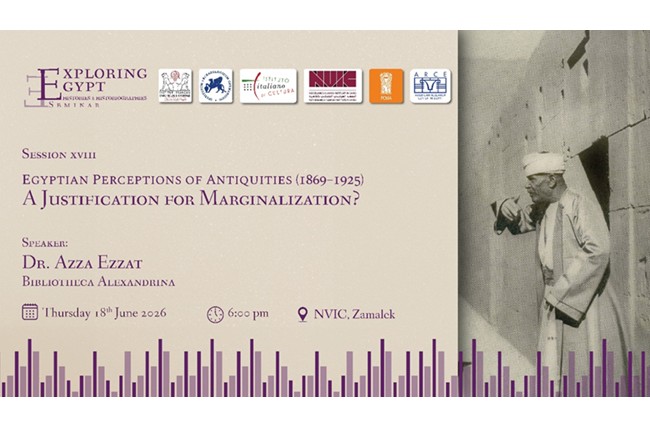
PERCEZIONI EGIZIANE DELLE ANTICHITÀ (1869–1925): UNA GIUSTIFICAZIONE PER L’EMARGINAZIONE?
A CURA DELLA DR.SSA AZZA EZZAT, RESPONSABILE DELLA SEZIONE RICERCA E PUBBLICAZIONI PRESSO IL CENTRO DELLA SCRITTURA E DELLE SCRITTURE, BIBLIOTHECA ALEXANDRINA.
La 18ª sessione del ciclo di seminari “Exploring Egypt: Histories and Historiographies” — un’iniziativa congiunta di Ifao, DAIK, CAI, PCMA, NVIC e ARCE — si terrà presso il NVIC a Zamalek. L’incontro ospiterà la Dr.ssa Azza Ezzat con una conferenza intitolata: “Percezioni Egiziane delle Antichità (1869–1925): Una giustificazione per l’emarginazione?”. La lezione è aperta al pubblico fino a esaurimento posti.
Sintesi La conferenza esamina le percezioni egiziane riguardo alle antichità tra il 1869 e il 1925, periodo caratterizzato dal controllo straniero, indagando se tali percezioni siano state utilizzate per giustificare l’emarginazione degli egiziani nel campo dell’egittologia. Verranno esplorati diversi atteggiamenti verso il patrimonio culturale, inclusi lo sfruttamento e il rifiuto dei reperti attraverso la contraffazione, il saccheggio e l’opposizione religiosa.
L’intervento ripercorre inoltre la difficile formazione degli egittologi locali attraverso quattro istituzioni educative, mettendo in luce figure pionieristiche come Ahmed Kamal, Selim Hassan, Sami Gabra, Labib Habachi e Hassan Sobhi. Verrà analizzata la competizione tra Francia, Germania e Gran Bretagna per il controllo dei reperti, l’esclusione degli egiziani dal Servizio delle Antichità e la loro limitata partecipazione ai forum scientifici internazionali.
Un’attenzione particolare sarà rivolta alla “prima generazione perduta” di egittologi egiziani e ai loro tentativi di arabizzare l’egittologia nonostante le critiche e gli ostacoli istituzionali. Infine, si discuteranno i successi successivi, tra cui l’istituzione degli studi di archeologia presso l’Università del Cairo, la fondazione della prima società archeologica d’Egitto nel 1925 e gli sforzi per migliorare la condizione dei dragomani (interpreti).
Relatrice La Dr.ssa Azza Ezzat è attualmente Responsabile della Sezione Ricerca e Pubblicazioni del Writing and Scripts Center presso la Bibliotheca Alexandrina. Ha conseguito il dottorato in Egittologia nel 2015. Attualmente conduce ricerche sulla metodologia del dizionario Geroglifico-Arabo-Francese di Ahmed Kamal Pasha. È membro di diverse istituzioni internazionali, tra cui l’Istituto Ellenico di Egittologia e il comitato di redazione di Current Research in Egyptology (CRE).
Giovedì 18 giugno, ore 18.00
NVIC (Istituto Neerlandese-Fiammingo). Via Mahmoud Azmi, 1 – Zamalek
EGYPTIAN PERCEPTIONS OF ANTIQUITIES (1869–1925): A JUSTIFICATION FOR MARGINALIZATION?
BY DR. AZZA EZZAT, HEAD OF THE RESEARCH AND PUBLICATION SECTION AT THE WRITING AND SCRIPTS CENTER, BIBLIOTHECA ALEXANDRINA
The 18th session of the seminar series ‘Exploring Egypt: Histories and Historiographies’, a joint initiative of the Ifao, DAIK, CAI, PCMA, NVIC, & ARCE will be hosted at the NVIC, Zamalek. This session features Dr. Azza Ezzat, and it is entitled “Egyptian Perceptions of Antiquities (1869–1925): A Justification for Marginalization?” The lecture is open to the public in the limit of available places.
Abstract This lecture examines Egyptian perceptions of antiquities between 1869 and 1925 under foreign control, questioning whether such perceptions were used as a justification for the marginalization of Egyptians within the field of Egyptology. It explores various attitudes toward heritage during this period, including the exploitation and rejection of antiquities through forgery, looting, and religious opposition to ancient remains.
The lecture also traces the restricted formation of Egyptian Egyptologists through four educational institutions, highlighting pioneering figures such as Ahmed Kamal, Selim Hassan, Sami Gabra, Labib Habachi, and Hassan Sobhi. In addition, it investigates the French, German, and British competition for control over antiquities, the exclusion of Egyptians from the Antiquities Service, and their limited participation in international scientific forums.
Particular attention is given to the first “lost” generation of Egyptian Egyptologists and their attempts to Arabize Egyptology despite criticism and institutional obstacles. Finally, the lecture discusses later achievements, including the establishment of archaeology and Egyptology studies at Cairo University, the foundation of Egypt’s first archaeological society in 1925, and Egyptian efforts to improve the condition and historical knowledge of dragomans (interpreters).
Dr. Azza Ezzat is currently the Head of the Research and Publication Section at the Writing and Scripts Center, Bibliotheca Alexandrina. Earned her PhD in Egyptology from the Faculty of Tourism and Hotels, Guidance Department, Alexandria University, in 2015. Dr. Ezzat currently conducting research on the methodology of Ahmed Kamal Pasha’s Hieroglyphic–Arabic–French Dictionary. She is a member of the General Assembly of the 33 Principal Partners and Founding Members of the Hellenic Institute of Egyptology, Athens. She has been selected as a member of the National Network of Science Centers and Museums (SciHer Network) at the Academy of Scientific Research and Technology. She is also a member in the Current Research in Egyptology CRE Editing Committee.
Exploring Egypt Seminar: Histories and Historiographies A joint collaboration between the Ifao (Institut français d’archéologie orientale) & the DAIK (German Archaeological Institute in Cairo), joined in 2025 by the CAI (Centro Archeologico Italiano), PCMA (Polish Centre of Mediterranean Archaeology Cairo), NVIC (Netherlands-Flemish Institute in Cairo) and ARCE (American Research Center in Egypt).
Thursday, 18th of June, at 6:00 PM
NVIC Netherlands-Flemish Institute, 1 Mahmoud Azmi Str., Zamalek